
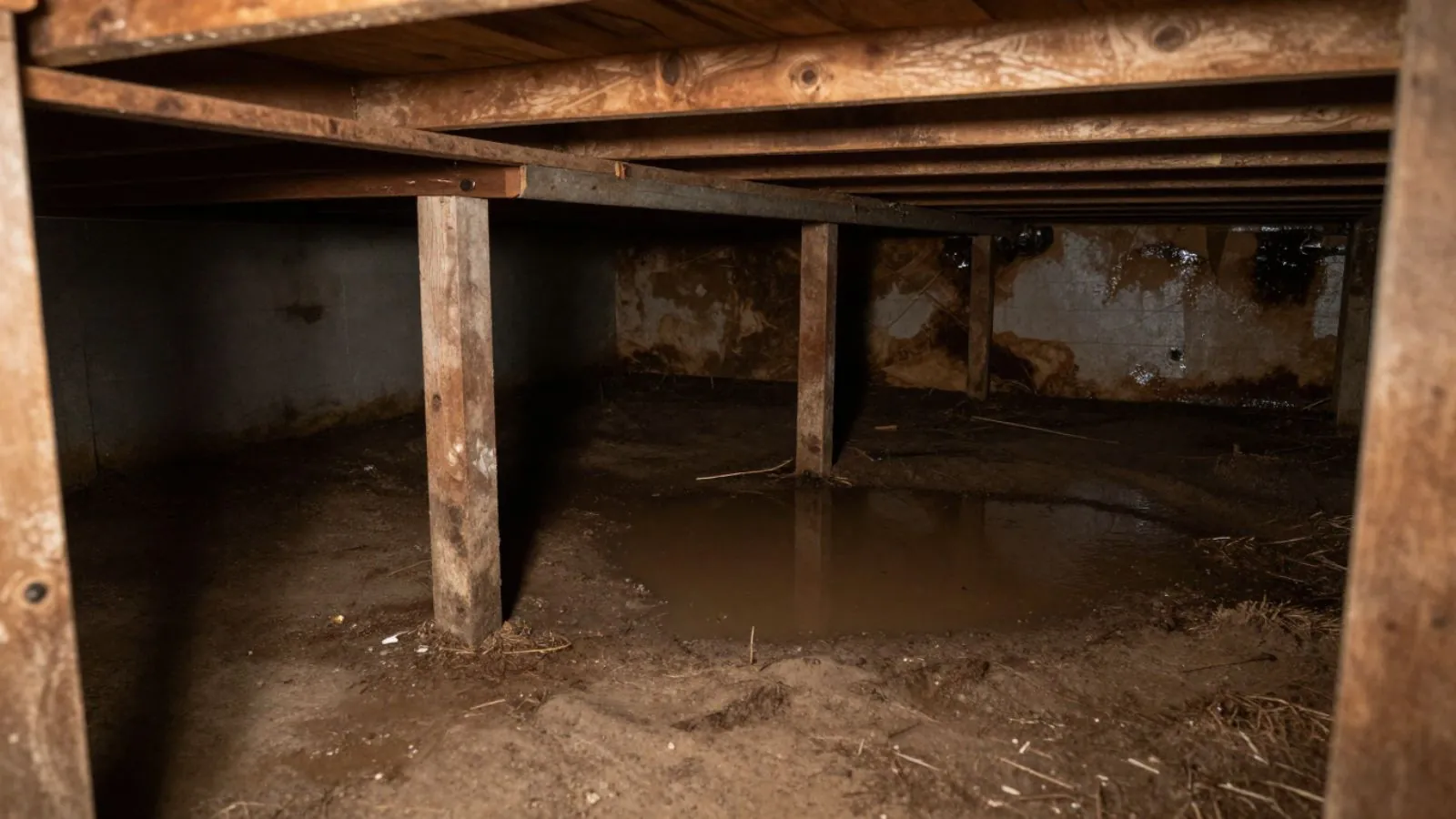
A musty smell after a leak or flood is usually a sign that something is still damp. The odor itself is a clue, not a diagnosis. It points toward moisture in a wall cavity, under flooring, in insulation or in a crawl space, and the fix is to find that moisture and dry it, not to cover the smell.
This guide covers where the smell tends to come from, how to look for it, and what to do. It is written for Mitchell, SD homeowners, and it stays within what a restoration crew can actually determine.
Why the smell lingers
Materials that stay damp can develop odor within days. Carpet pad, the back of drywall, insulation and wood framing all hold moisture longer than the surface suggests. If a room was cleaned and fans were run but the structure was never measured, hidden pockets may still be wet.
Air fresheners and ozone machines treat the smell, not the cause. If the smell returns after a few days, the moisture is probably still there.
Where to look
| Place | What to check | Next step |
|---|---|---|
| Behind baseboards and in wall bases | Cool or damp surface, stained paint | Moisture meter reading |
| Under carpet and pad | Damp pad, odor near the edges | Lift a corner and inspect |
| Basement walls and floor | Damp patches, white mineral residue | Check for outside water sources |
| Crawl space | Damp insulation, wet soil, standing water | Inspect with a light and PPE |
| Under cabinets | Damp cabinet floors, rusty fittings | Look for slow leaks |
A moisture meter and a thermal camera find wet materials without opening walls. If a reading is high, the next step is a small, targeted opening, not tearing out the whole room.
What fixes it
- Find and stop any active water source.
- Remove materials that are saturated or contaminated and cannot be dried.
- Dry the structure with air movers and dehumidifiers until readings return to normal.
- Clean the surfaces that remain.
- Recheck readings and the smell after a few days.
Drying is described on the structural drying and dehumidification page. For carpet, see carpet water damage restoration, since pad is a frequent source of odor.
Humidity after heavy Mitchell rain
After the record rain of June 20 to 22, 2024, when the National Weather Service in Sioux Falls measured 8.55 inches over three days in Mitchell, damp basements and crawl spaces were a likely follow-up for homes near low ground. A smell that shows up days or weeks after such an event often traces to materials that never fully dried.
We do not offer mold testing results or health advice. For health questions, talk to a physician.
Is it mold?
Possibly, but a smell alone does not tell you. Mold needs moisture and organic material, which a wet wall or carpet pad provides. We do not offer mold services or testing. If you see growth, want testing or have health symptoms, contact a qualified professional and a physician. For the water problem under it, drying is still the first step.
Fast, complete drying lowers the chance that growth starts. No company can promise it never will.
What not to do
- Do not paint over a stained, musty wall until it reads dry.
- Do not run heat alone to dry a room, since humid air just moves the moisture.
- Do not leave wet carpet pad in place under new flooring.
- Do not seal a damp crawl space or basement wall before the water source is stopped.
Basements and crawl spaces
These are the most common sources, because they sit below grade and can hold moisture from the ground. Basement water damage cleanup and crawl space water damage explain what we look for. We serve Mitchell and towns such as Ethan and Mount Vernon.
Drying goals in the ANSI/IICRC S500 standard are set against a dry reference reading, which is why a good crew measures an unaffected area of the same house before it decides a wet one is finished.
A simple home check
You can learn a lot without equipment. Close the room for an hour, then enter and notice where the smell is strongest. Smell near the floor often points to carpet pad or wall bases. Smell near the ceiling suggests the attic or a roof leak. Check inside closets and cabinets on exterior walls, and look for staining, peeling paint or small white or dark patches.
Press gently on drywall at the base of walls. Soft or crumbling drywall is wet or has been. Check behind furniture that has not moved in a long time, because a leak behind a bookcase can run for months.
When the source is outside
Sometimes the smell comes from water entering the home on a recurring basis, such as through a foundation crack or a window well. In that case drying fixes the symptom while the leak returns. Ask whoever is doing the drying to help trace the entry point, then involve a foundation or drainage contractor if it points outside the building. Storm water damage cleanup describes cases where water enters repeatedly with each heavy rain.
Give any fix a few days, then check again. Walk into the room first thing in the morning after it has been closed overnight and note whether the smell is weaker, the same or stronger. A smell that fades as readings fall is a good sign. One that comes back means moisture is still hiding somewhere, and the search should continue.
Water already in the house?
Reading can wait. Call the dispatch line and we tell you what to do next.
Why does my Mitchell basement smell musty after heavy rain?
Rain can raise soil moisture and push water through foundation cracks or floor joints. After the 8.55 inches the National Weather Service recorded June 20 to 22, 2024, damp lower levels were a likely result. A moisture check shows whether materials are still wet.
Can a dehumidifier alone fix the smell?
It helps with humidity, but it does not remove saturated materials or find hidden wet spots.
Do you remove mold?
No. We do not offer mold services. We dry water damage and can tell you whether materials are still wet.
How long before a musty smell develops?
It can begin within a few days of materials staying wet. Time varies with the material and the room.
Should I leave the house?
For health concerns, ask a physician. If there is sewage or standing water, stay out of the area until it is addressed.